


Introduction
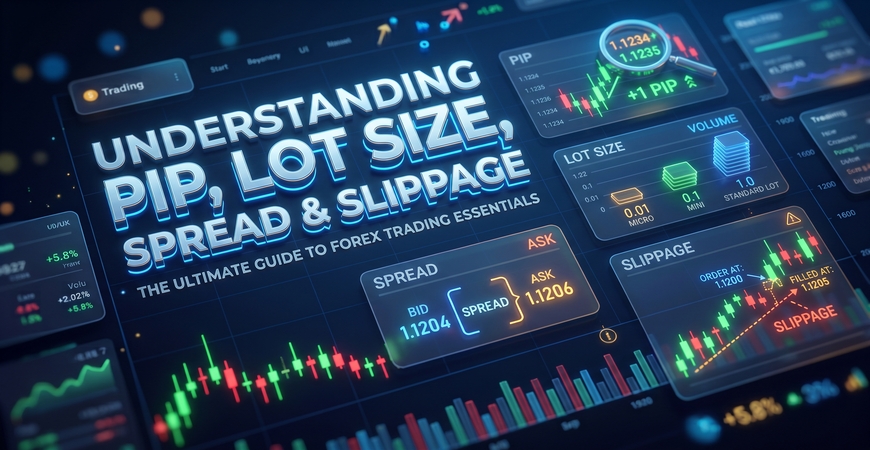
To execute trades profitably and manage capital effectively, every trader must understand the foundational mechanics of price movement, position sizing, execution costs, and order filling. In modern financial markets, four core concepts govern every trade: Pip (the unit of price movement), Lot Size (the volume of exposure), Spread (the primary transaction cost), and Slippage (the difference between expected and executed price).
This guide breaks down each metric mathematically and walks through a complete, step-by-step real-world trading scenario showing how pip values, bid/ask spreads, and market slippage interact in live trading conditions.
1. What is a Pip and a Pipette?
A Pip stands for Percentage in Point or Price Interest Point. It is the standardized unit measuring the smallest conventional price change in an exchange rate.
- Standard Currency Pairs (4th Decimal): For most major currency pairs (such as EUR/USD, GBP/USD, and AUD/USD), 1 pip equals 0.0001 of the quote currency. If EUR/USD moves from 1.0850 to 1.0851, it has moved exactly 1 pip.
- Japanese Yen Pairs (2nd Decimal): Because the Japanese Yen (JPY) has a much smaller base value, 1 pip equals 0.01. If USD/JPY moves from 150.20 to 150.25, it has moved 5 pips.
What is a Pipette (Fractional Pip)?
Modern electronic trading platforms like MetaTrader 5 (MT5) quote prices with institutional precision using an extra fractional decimal place known as a Pipette:
- 1 Pipette = 0.1 Pip (one-tenth of a pip).
- Standard pairs are quoted to 5 decimal places (e.g., EUR/USD at 1.08505). The 5th digit represents half a pip (5 pipettes).
- JPY pairs are quoted to 3 decimal places (e.g., USD/JPY at 150.253). The 3rd digit represents 3 pipettes.
| Instrument Category | Quoted Price Example | Pip Location (1.0 Pip) | Pipette Location (0.1 Pip) |
|---|---|---|---|
| Major Pairs (EUR/USD) | 1.08542 | 4th Decimal (0.0001) | 5th Decimal (0.00001) |
| JPY Pairs (USD/JPY) | 150.284 | 2nd Decimal (0.01) | 3rd Decimal (0.001) |
| Spot Gold (XAU/USD) | 2,650.50 | 1st Decimal ($0.10) | 2nd Decimal ($0.01 / Cent) |
2. Understanding Lot Sizes (Volume)
In financial trading, volume is measured in Lots. A lot defines the standardized contract size or number of units of the base currency being bought or sold.
- Standard Lot (1.00 Lot): Represents 100,000 units of the base currency. In EUR/USD, 1 standard lot represents €100,000.
- Mini Lot (0.10 Lot): Represents 10,000 units of the base currency (one-tenth of a standard lot).
- Micro Lot (0.01 Lot): Represents 1,000 units of the base currency. This is the minimum volume allowed on institutional ECN accounts, ideal for precise risk sizing.
| Lot Type | Volume in MT5 | Contract Size (Units) | Approximate Pip Value (EUR/USD) |
|---|---|---|---|
| Standard Lot | 1.00 | 100,000 | $10.00 / pip |
| Mini Lot | 0.10 | 10,000 | $1.00 / pip |
| Micro Lot | 0.01 | 1,000 | $0.10 / pip |
3. How to Calculate Pip Value
The monetary value of a single pip depends directly on the Lot Size traded and the Quote Currency (the second currency in the pair).
Formula for Pip Value:
Pip Value = One Pip in Decimals × Lot Size × Contract Size
Example A: When USD is the Quote Currency (EUR/USD, GBP/USD)
Trading 1.00 Standard Lot on EUR/USD:
Pip Value = 0.0001 × 1.00 × 100,000 = $10.00 USD per pip
Trading 0.20 Lots on EUR/USD:
Pip Value = 0.0001 × 0.20 × 100,000 = $2.00 USD per pip
Example B: When USD is Not the Quote Currency (USD/CAD)
If the quote currency is Canadian Dollars (CAD), the initial pip value is calculated in CAD and then converted back into your USD account balance by dividing by the exchange rate:
Pip Value (USD) = (0.0001 ÷ USD/CAD Exchange Rate) × Contract Units
If USD/CAD is trading at 1.3500 with 1 standard lot: (0.0001 ÷ 1.3500) × 100,000 = $7.41 USD per pip.
4. Bid Price, Ask Price, and Spread
Every financial quote displays two live prices simultaneously:
- Bid Price: The price at which the broker or liquidity provider will buy from you. This is the price you receive when you open a Sell (Short) position or close a Buy trade.
- Ask Price (Offer): The price at which the broker or liquidity provider will sell to you. This is the price you pay when you open a Buy (Long) position or close a Sell trade.
What is Spread?
The Spread is the difference between the Ask price and the Bid price. It represents the primary cost of opening a trade:
Formula for Spread:
Spread (in Pips) = (Ask Price − Bid Price) ÷ 1 Pip Size
Monetary Cost of Spread = Spread in Pips × Pip Value
For example, if EUR/USD is quoted as Bid: 1.08502 and Ask: 1.08505, the spread is 1.08505 − 1.08502 = 0.00003, which equals 0.3 pips (3 pipettes).
Raw ECN Spreads vs. Zero Spread Accounts
In true ECN environments like Solid ECN, trades are executed against institutional liquidity providers without artificial dealer markups:
- Raw ECN Spreads: Major pairs fluctuate with institutional interbank pricing, frequently starting from 0.0 pips on EUR/USD or USD/JPY during liquid London and New York sessions.
- Zero Spread Model: By eliminating dealer markups, the trader only pays a transparent, fixed commission per lot, significantly reducing execution drag for scalpers and high-frequency traders.
5. What is Slippage in Market Execution?
Slippage refers to the difference between the expected price of a trade (the price you see on your screen when you click Buy or Sell) and the actual price at which the trade is filled on the liquidity server.
Formula for Slippage:
Slippage = Executed Fill Price − Requested Order Price
Slippage occurs in all genuine market-execution trading environments and is classified into two types:
- Negative Slippage: When a Buy order is filled at a higher price than requested, or a Sell order is filled at a lower price. This unfavorable fill increases your entry cost.
- Positive Slippage: In true No-Dealing-Desk (NDD) ECN execution, if market prices improve during order transmission, your order is filled at the better available price, giving you instant savings.
Primary Causes of Slippage
- High Market Volatility: During major macroeconomic news releases (such as US Non-Farm Payrolls or Central Bank Interest Rate decisions), prices jump in milliseconds before an order can cross the network.
- Low Liquidity or Market Gaps: Over weekends or holiday sessions, the order book becomes thin. If there are insufficient matching orders at your requested level, the server fills your lot size at the next best available price.
- Network Latency: The physical transmission time between your trading computer and the broker’s data center server. Low-latency VPS hosting helps minimize this delay.
6. Practical Step-by-Step Numerical Example
To demonstrate how Lot Size, Pip Value, Spread, and Slippage operate together in live conditions, let’s walk through an actual intraday trade:
1. Trade Parameters
- Account Balance: $5,000
- Pair: EUR/USD
- Trade Direction: Buy (Long)
- Volume: 0.50 Lot (50,000 EUR Contract Size)
- Quoted Market Prices at Click:
- Bid: 1.08500
- Ask: 1.08503
- Stop Loss Target: 25 pips below entry
- Take Profit Target: 50 pips above entry
2. Calculating Pip Value for 0.50 Lot
Pip Value = 0.0001 × 0.50 × 100,000 = $5.00 USD per pip
Each pip the market moves represents a gain or loss of exactly $5.00.
3. Calculating Initial Spread Cost
The spread between Ask (1.08503) and Bid (1.08500) is 0.3 pips (0.00003):
Spread Transaction Cost = 0.3 pips × $5.00/pip = $1.50 USD
Because Buy trades open at the Ask price and close at the Bid price, this position opens with a floating P/L of -$1.50.
4. Incorporating Execution Slippage
Suppose you clicked Buy right as an economic report was published. Due to rapid price movement during network transmission, your order filled at 1.08507 instead of the requested 1.08503:
- Requested Price: 1.08503
- Actual Filled Price: 1.08507
- Slippage: 1.08507 − 1.08503 = 0.4 pips negative slippage (4 pipettes)
- Slippage Impact: 0.4 pips × $5.00 = -$2.00 USD in adverse fill difference.
5. Outcome Analysis (Profit & Loss at Target)
Your trade is filled at 1.08507. Let’s examine what happens when price hits your Take Profit or Stop Loss:
- Scenario A (Take Profit Hit at 50 Pips):
The Bid price rises to 1.08557 (+50 pips above your fill price).
Realized Profit = 50 pips × $5.00/pip = +$250.00 USD
New Account Balance: $5,000 + $250.00 = $5,250.00 - Scenario B (Stop Loss Hit at 25 Pips):
The Bid price drops to 1.08482 (−25 pips below your fill price).
Realized Loss = −25 pips × $5.00/pip = -$125.00 USD
New Account Balance: $5,000 − $125.00 = $4,875.00
7. Best Practices to Minimize Spread and Slippage
- Trade During Peak Overlap Sessions: Spreads are tightest and liquidity is highest during the London-New York session overlap (13:00 to 17:00 UTC).
- Use Limit Orders for Entry: Unlike Market Orders (which execute immediately at whatever price is available), Buy Limit and Sell Limit orders guarantee that your fill price will be equal to or better than your requested price, eliminating negative entry slippage.
- Choose True ECN Execution: Trading with an authentic ECN broker provides direct depth-of-market access, transparent commission structures, and positive slippage pass-through.
Conclusion
Understanding how Pips, Lot Sizes, Spreads, and Slippage interact mathematically is what separates professional traders from retail gamblers. By precisely sizing your lots according to pip values and accounting for real-world spread and slippage dynamics, you can control risk accurately on every single trade.


